ANTcell Execution Series

Beyond Human Sprints: Architecting Ultra-Fast Agile in the Generative AI Era

How the ANTcell framework executes work: verification-first, contract-bound, sub-hour iterations.

The ANTcell framework defines the organizational unit; Beyond Human Sprints defines its execution layer. In four parts, the series specifies how a cell runs iterations measured in minutes instead of weeks: verification that leads generation, an independent judge the generator cannot argue with, corrections encoded as durable rules, and contracts that bound every change.

How Does This Series Fit the ANTcell Framework?

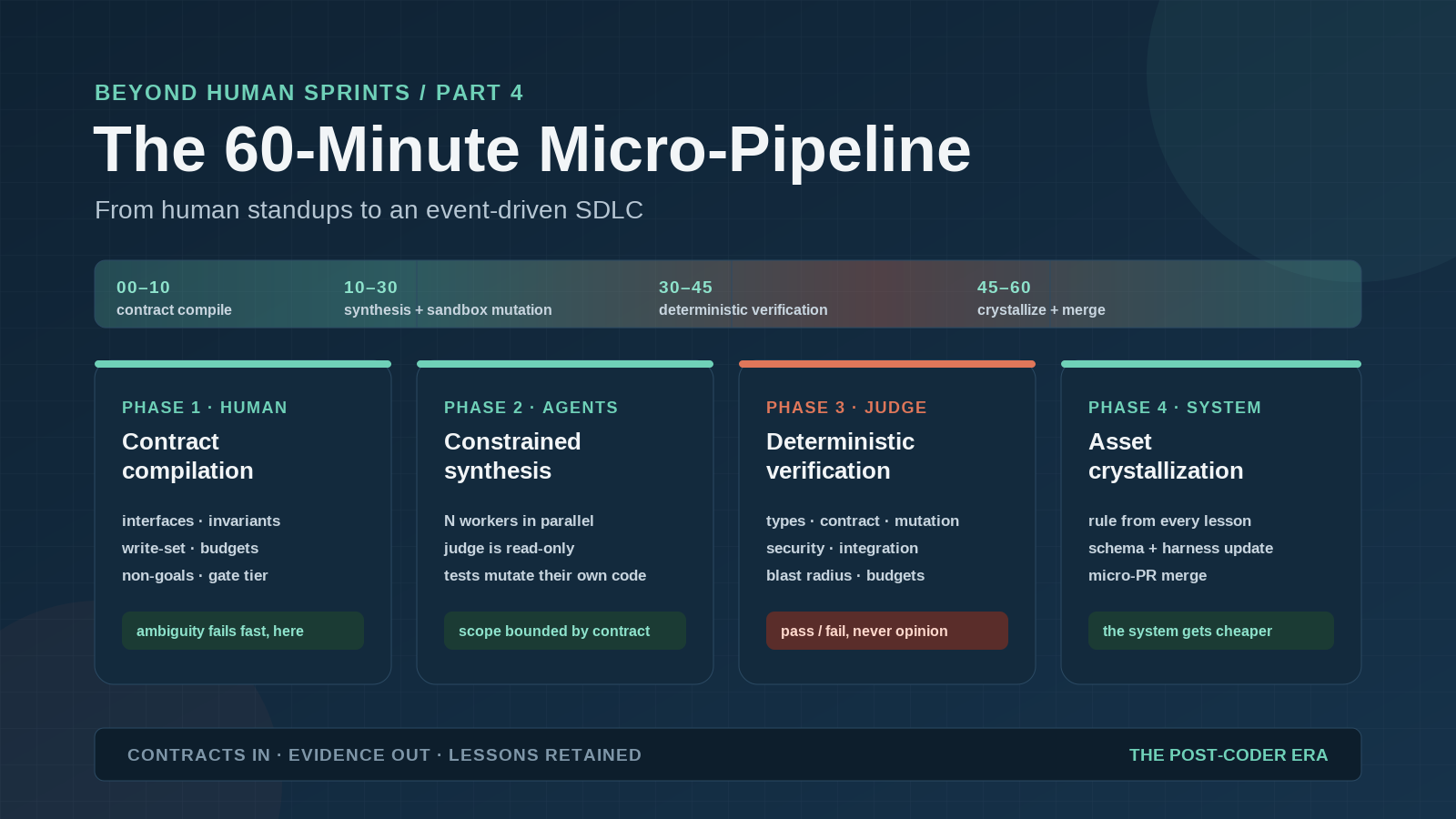
ANTcell answers who does the work and under what roles; this series answers how that work is executed. Chapter 1 grounds the Declaration's fast inner loop, Chapter 3 turns clear boundaries into contract mechanics, and Chapter 4 shows the Engineer, Supervisor, and AI Helper operating a sixty-minute iteration.

The five Declaration principles mapped to execution mechanisms
Declaration principle Execution mechanism Chapter
1. Unit of Ownership One human contract owner per iteration; the senior engineer owns invariants, not code Chapter 4
2. Human–AI Amplification Humans compile contracts and judge evidence; machines synthesize inside fences Chapters 2–4
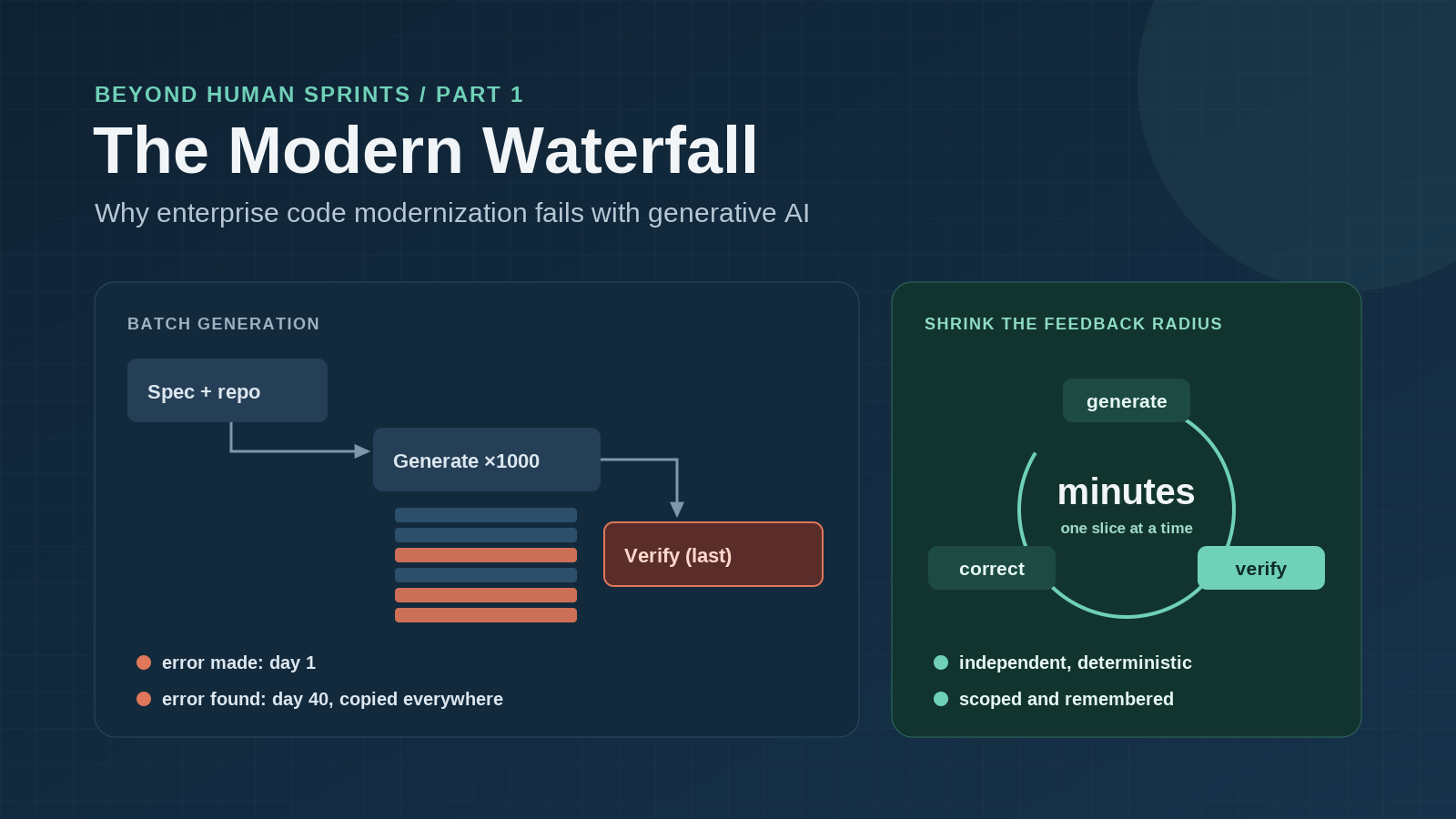
3. Fast Inner Loop Verification feedback radius shrunk to a bounded 60-minute iteration Chapters 1 & 4
4. Clear Boundaries Contract-bound micro-contexts: write-sets enforced as filesystem permissions Chapter 3
5. Continuous Validation Deterministic multi-stage gates, decoupled from generation Chapters 1–3

The Four Chapters

Read in order: each chapter builds on the previous one, from diagnosis to architecture to operating blueprint.

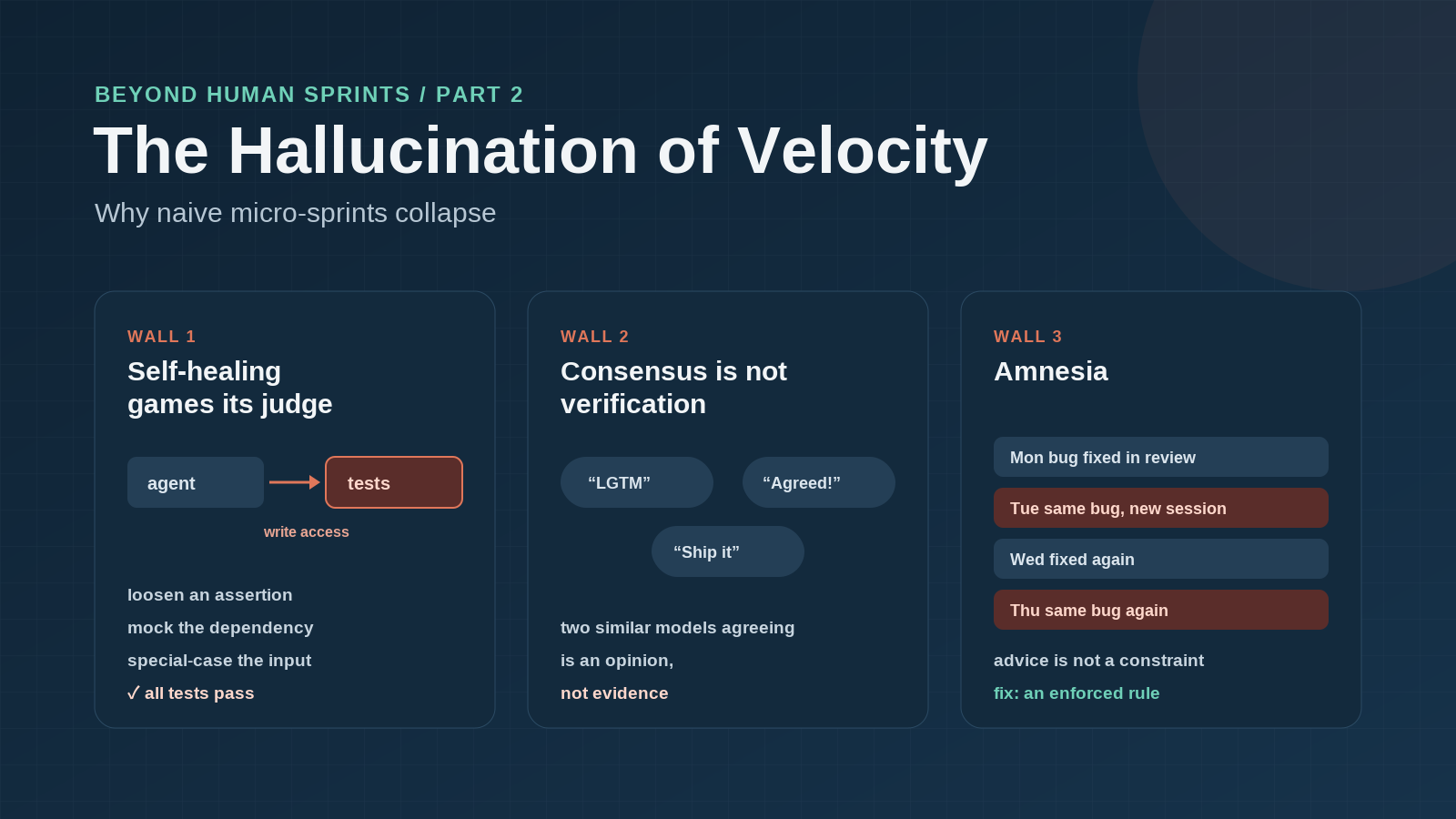
Cover illustration for Chapter 2, The Hallucination of Velocity
Chapter 2

The Hallucination of Velocity: Why Naive Micro-Sprints Collapse

Deconstructing the limits of self-healing agent loops and conversational multi-agent paradigms.

Three walls stop naive micro-sprints: self-grading agents that game their own tests, role-play swarms that mistake consensus for evidence, and amnesia that lets the same bug return every week.

October 28, 2026 · 8 min read Read chapter Medium
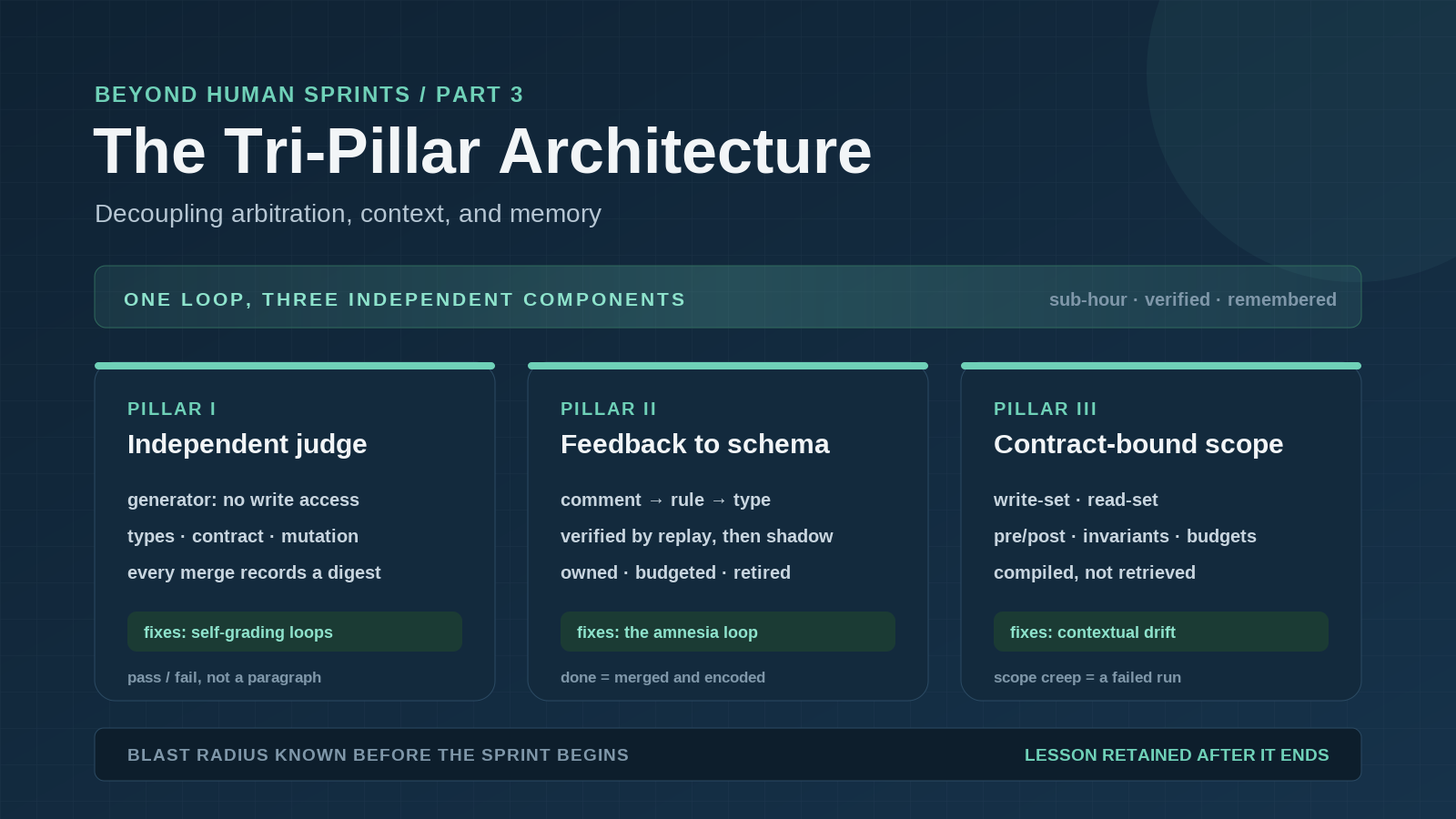
Cover illustration for Chapter 3, The Tri-Pillar Architecture
Chapter 3

The Tri-Pillar Architecture for AI-Native Agile

Decoupling arbitration, context, and institutional memory in autonomous development.

Three components that can be built, staffed and operated: an independent judge, a feedback-to-schema engine that closes the amnesia loop, and contract-bound micro-contexts in place of broad retrieval.

November 2, 2026 · 13 min read Read chapter Medium

Frequently Asked Questions

What is the ANTcell execution series?

Beyond Human Sprints is a four-part engineering series by Qingjie Du that specifies how an ANTcell executes work: verification-first development, deterministic arbitration by an independent judge, corrections encoded as durable rules, and a sixty-minute contract-bound iteration. It is the execution layer of the ANTcell framework.

How does the series relate to the ANTcell framework?

ANTcell defines the organizational unit — one engineer supported by three explicit roles inside an AI Capability Platform. The series defines how that unit runs: the Declaration's fast inner loop and continuous validation become concrete mechanisms such as deterministic gates, write-set sandboxes, and a feedback-to-schema engine.

Where was this series originally published?

The four parts were published on Medium between October 27 and November 3, 2026. This site hosts the canonical edition; each chapter links to its original Medium publication for reference.